Scaling Up: What Saipem’s $1.8 Billion EPCI Win Reveals About Middle East Offshore Momentum
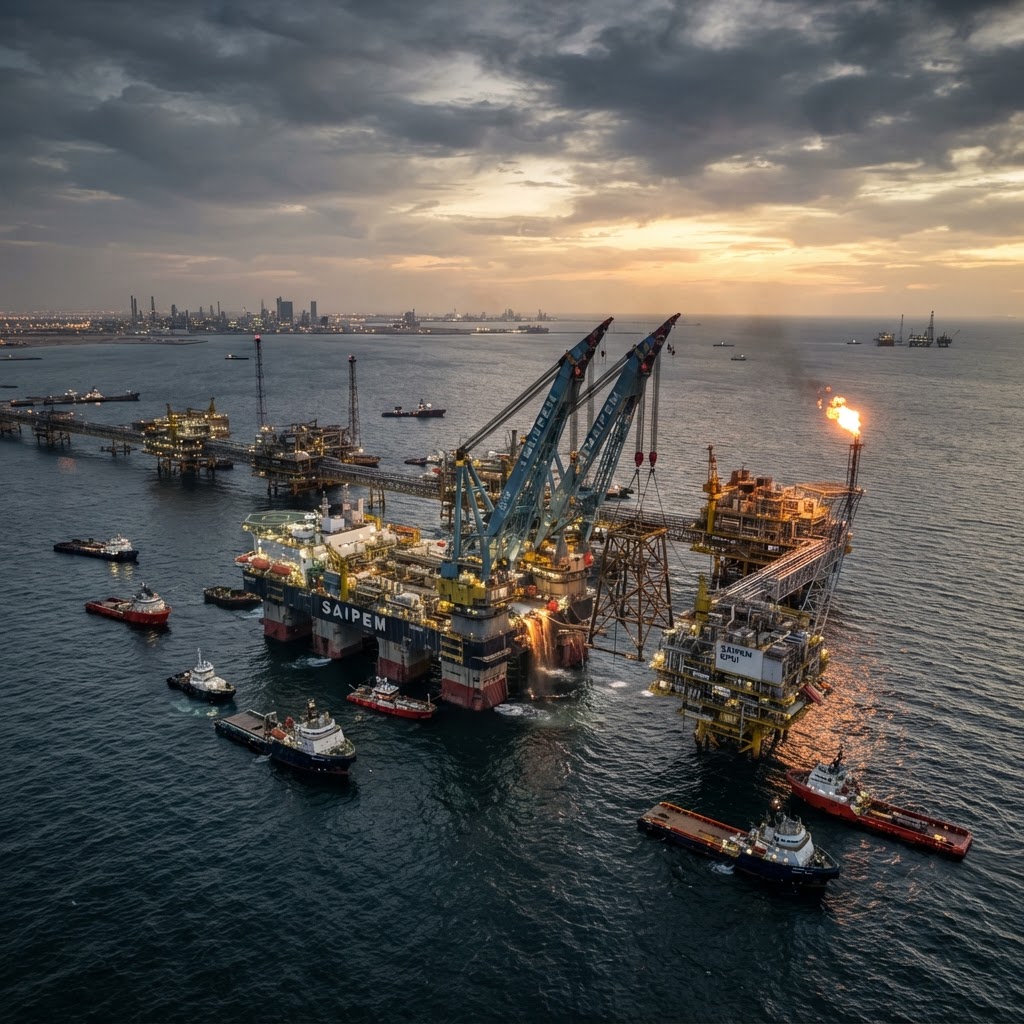
Saipem’s recent $1.8 billion offshore contract highlights the sustained appetite for massive capital investment in the Middle East’s upstream sector, even as the global energy transition accelerates.
In a move that reaffirms the Middle East's position as the global epicenter of upstream activity, Saipem has secured a massive $1.8 billion contract for offshore Engineering, Procurement, Construction, and Installation (EPCI) services. While the global narrative often focuses on the divestment from fossil fuels, the reality on the ground in the Gulf remains one of strategic expansion and technical intensification. At Atticus Energy, we see this contract as a clear indicator that regional majors are doubling down on their core strengths to ensure global energy security during a volatile transition period.
The Complexity of Modern Offshore Delivery
The scope of a $1.8 billion EPCI contract is staggering. It involves not just the fabrication of platforms and the laying of subsea pipelines, but the integration of advanced digital monitoring and automated control systems. For a lean engineering consultancy, the focus here is on the 'I' in EPCI—Installation. The logistical choreography required to deploy heavy-lift vessels and subsea robots in the Arabian Gulf’s busy maritime corridors requires a level of project management maturity that few firms possess. Saipem’s win is a testament to the value of deep-water expertise and the ability to manage multi-year project lifecycles without succumbing to the 'megaproject paradox' of delays and budget overruns.
Capital Investment and Regional Stability
This investment comes at a time when the International Energy Forum (IEF) has warned that upstream investment must rise significantly to meet projected demand by 2030. The Middle East is currently the only region capable of absorbing and deploying this level of capital with the necessary speed. From a strategic advisory perspective, this contract is a signal to the supply chain: the demand for high-spec offshore services, specialized steel, and subsea engineering talent will remain at a premium for the foreseeable future. We advise our clients to look closely at the sub-contracting opportunities these Tier-1 wins create, particularly in the realms of environmental monitoring and asset integrity services.
Engineering for a Dual-Track Future
What is most interesting about the current wave of Middle Eastern offshore projects is the 'hidden' transition technology being deployed. Modern EPCI contracts now frequently include requirements for reduced flaring, carbon capture readiness, and electrification of offshore facilities. We are no longer building the oil fields of the 1990s; we are building high-efficiency, low-emission energy hubs. For the engineering community, the challenge is to deliver these massive projects with a 'lean' footprint, ensuring that every dollar of the $1.8 billion contributes to a more resilient and sustainable energy infrastructure. The Saipem contract is not just a win for the company; it is a vote of confidence in the long-term viability of the Middle East’s offshore energy sector.