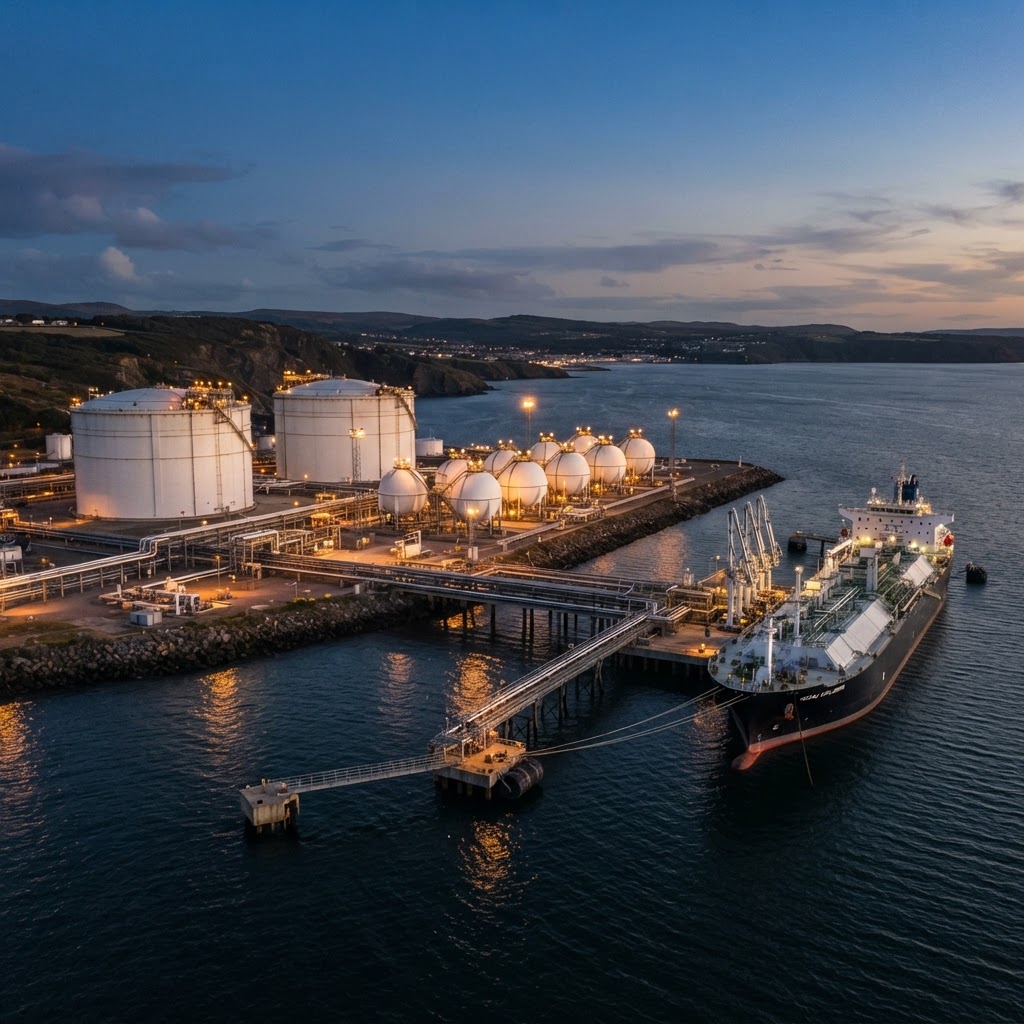
Refrigerated or pressurised? Choosing an LPG storage and export strategy
Pressurised spheres are simple and fast to build. Refrigerated tanks store far more product per unit of steel and suit large export volumes. The right answer depends on throughput, ship size and how much complexity the operator can carry.
The situation
An owner needs more LPG storage at a terminal or gas plant. The decision is between pressurised spheres or bullets at ambient temperature, or a fully refrigerated tank at about −42 °C (propane) / −5 °C (butane) near atmospheric pressure. The choice sets the plot area, the refrigeration and boil-off load, how the tank is filled and emptied, and the major-accident profile for decades.
Two ways to keep a gas liquid
LPG is a gas at ambient conditions. To store it as a liquid you either hold it under pressure or cool it below its boiling point.
Pressurised storage keeps propane and butane at ambient temperature in spheres or bullets, at the vapour pressure of the product on the hottest design day. The vessels are thick-walled, but there is no refrigeration plant. Loading is simple and the facility can be built quickly.
Refrigerated storage cools the product until its vapour pressure is close to atmospheric. Propane boils at about −42 °C and butane at about 0 °C, so they are stored in large insulated tanks with only a small overpressure. Because the tank shell does not need to resist much pressure, one refrigerated tank can hold many times the volume of a sphere.
Where the crossover sits
There is no universal tonnage at which refrigeration becomes the better answer, but the drivers are consistent:
- Export volume and ship size. Very large gas carriers are fully refrigerated. If the market is long-haul, refrigerated storage at the terminal is usually needed to load them efficiently.
- Plot space. Spheres need generous spacing for fire protection. A few large tanks can use far less land for the same inventory.
- Schedule and capability. Spheres are a known quantity for most contractors. Refrigerated tanks, especially full-containment designs, take longer to build and need specialist inspection.
- Operating complexity. A refrigerated terminal is a process plant. Compressors, condensers and controls need trained operators and a maintenance plan.
Many terminals end up with both. Spheres act as rundown or buffer storage, and a refrigeration step chills product into the large tanks ahead of export.
The boil-off loop
Even with good insulation, heat gets in through the roof, shell and base. A small fraction of the liquid boils off every day. That vapour has to go somewhere or the tank pressure rises.
The standard answer is a reliquefaction loop (see the diagram): a boil-off gas (BOG) compressor takes vapour from the tank, a condenser turns it back to liquid, and the liquid is flashed down and returned. The design questions that matter most are:
- What is the worst credible boil-off rate? Ship loading and warm rundown usually exceed steady-state heat leak by a wide margin.
- How many trains, and how much spare? A single compressor is cheap until it trips during a loading.
- Can the plant turn down? Steady-state boil-off is small. Compressors sized for ship loading must still run stably at low load.
- What happens on loss of refrigeration? Tank pressure rise, relief, and flare or vent capacity must be checked for this case.
Questions to settle at concept stage
- Separate propane and butane tanks, or a mixed product? This fixes tank count and which ships can load.
- Which grade specifications must the export meet, and where are they controlled?
- Will the terminal also import product (for example gasoline or condensate), and do the systems share jetties or lines?
- Is the site greenfield, or are existing tanks being brought back into service? Rehabilitation brings its own constraints on inspection access and design codes.
Key Takeaways
- Pressurised storage suits smaller volumes, short-sea shipping and fast schedules.
- Refrigerated storage wins at scale, but brings a refrigeration plant that must be run, spared and maintained.
- Boil-off handling and ship vapour return often size the refrigeration package, not tank heat leak alone.
- Decide early whether products are stored separately (propane, butane) or as a mix, because it fixes tank count and ship compatibility.
How Atticus helps
We support operators from concept screening to start-up. That covers storage strategy and concept selection, refrigeration and BOG system sizing, HAZID and HAZOP facilitation, and brownfield condition assessment for existing terminals.
Real-world examples
Feyzin refinery, France (1966)
During a routine drain of water from a pressurised propane sphere, the drain valves froze open. The resulting vapour cloud ignited and the sphere later failed by BLEVE, killing firefighters and workers. It is a key reference for drain-valve design, water draw-off practice and fire protection of pressurised storage.
Read the investigation / sourceSan Juanico LPG terminal, Mexico (1984)
A leak at a large LPG distribution terminal led to a fire and a series of BLEVEs across spheres and bullets. Hundreds of people died in housing that had grown up around the site. The lessons are about inventory, spacing, fire water and land-use planning around pressurised storage.
Read the investigation / sourceIf you get it wrong
- Getting the storage type wrong can lock in decades of excess refrigeration power or loading constraints.
- Pressurised storage that is under-protected has BLEVE potential; refrigerated storage that is mis-designed has roll-over and cold-spill hazards.
- Undersized boil-off handling leads to flaring or venting during ship loading.
- Spacing or land-use errors can make the site impossible to permit or expand.
Relevant standards
Links go to the publisher's official page (ISO, IEC, BSI, API, NFPA, HSE and others). Most standards must be bought from the publisher.
- BS EN 14620-1:2024 — Refrigerated liquefied gas tank systems (0 to -196 °C)knowledge.bsigroup.com
- NFPA 58 — Liquefied Petroleum Gas Codenfpa.org
- API standards catalogue (API 520/521, 580/581, 618, 625, 650, 754 and more)api.org
- ISO 9162:2013 — Liquefied petroleum gases: specificationsiso.org
- HSE — Liquefied petroleum gas (LPG)hse.gov.uk
Further reading
- Liquefied petroleum gas — overviewen.wikipedia.org
- BLEVE — boiling liquid expanding vapour explosionen.wikipedia.org
- SIGTTO publications — gas tanker and terminal practicesigtto.org
Take this briefing with you
A one-to-two page PDF summary: situation, diagram, key takeaways, consequences, examples and standards.