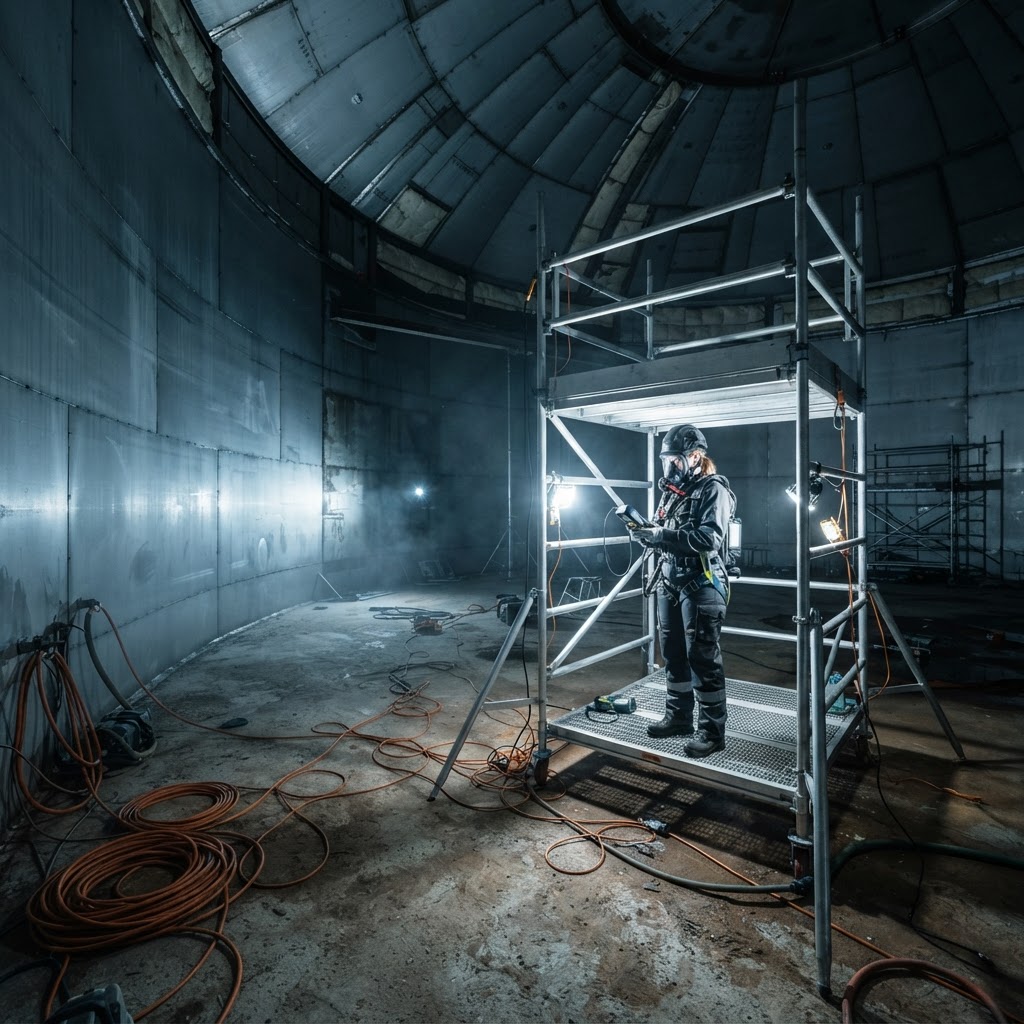
Refrigerated tank entry and return to service: a step-by-step view
Internal inspection of a refrigerated tank is one of the highest-risk routine jobs in a terminal. Warm-up, purge, gas-freeing, entry and cooldown each have their own hazards, and every step needs time.
The situation
Taking a refrigerated LPG tank out of service for internal inspection is a long, high-risk sequence: pump-out, warm-up, inerting, gas-freeing, positive isolation, confined-space entry, inspection and repair, then drying, purging and controlled cool-down. Each step has strict acceptance criteria.
Why this job needs care
Large refrigerated tanks are designed to stay cold for decades. Taking one out of service for internal inspection or repair means warming it to ambient, making the atmosphere safe for people, working inside a large confined space, and then bringing it back without damaging the inner tank or insulation. Each stage has its own hazards.
The sequence
1. Empty. Pump out as much liquid as possible. The remaining heel boils off during warm-up, so its quantity sets warm-up duration and vapour handling.
2. Warm-up. Raise the temperature at a controlled rate, often with warm gas circulation. Rapid warming can stress the inner tank and the base insulation.
3. Purge to inert. Displace hydrocarbon vapour with nitrogen until the atmosphere is below the flammable range. Monitor at several points, including low spots and dead legs.
4. Air-in and gas-free. Replace nitrogen with air. Confirm oxygen content and the absence of hydrocarbons before any entry is considered. An oxygen-deficient atmosphere is invisible and fatal.
5. Entry and inspection. Work under a confined-space permit with positive isolation of every connection (spades or blinds, not just closed valves), continuous gas monitoring, forced ventilation, a standby person and a rescue plan suited to the tank geometry.
6. Close-up. Complete repairs, sign off inspection findings, remove temporary equipment and confirm the tank is clean and clear.
7. Dry-out and purge. Remove moisture until the dew point is safely below the lowest operating temperature, then purge with nitrogen again. Moisture left behind can freeze in valves and instruments.
8. Cool-down. Introduce cold product or vapour slowly, watching temperature differences across the shell and base. This is the stage where thermal stress damage most often occurs.
9. Fill and return to service.
Common watch-points
- Trapped liquid in dead legs or instrument connections that boils off after the tank is declared gas-free.
- Isolation lists that miss small-bore connections.
- Rescue arrangements that assume a ladder or manway the team has never actually used.
- Schedule pressure that compresses warm-up or cooldown time.
Planning documents worth preparing
- A job hazard analysis for each stage, not only for the entry itself.
- An isolation and spading list, checked in the field.
- A safe system of work dossier that ties together permits, gas testing, ventilation and rescue.
- A clear RACI showing who authorises each step.
Key Takeaways
- Plan the full cycle, from emptying to refilling, before the tank is taken out of service.
- Control warm-up and cooldown rates to protect the inner tank and insulation.
- Gas testing and positive isolation are the foundation of a safe entry.
- Have a rescue plan that has actually been rehearsed for the specific tank.
How Atticus helps
We prepare tank entry and return-to-service plans, review isolation lists and job hazard analyses, and support inspection scoping so the outage delivers the data the integrity team needs.
Real-world examples
DuPont La Porte toxic release — CSB (2014)
Workers died during a toxic release linked to draining and venting operations on a process system. The CSB identified weaknesses in hazard recognition, ventilation and procedures, which apply directly to decommissioning and gas-freeing work.
Read the investigation / sourcecool-down too fast
After repairs, a tank was cooled down faster than the specified rate to recover lost storage days. Uneven temperatures over-stressed the inner tank bottom corner. Leak detection alarms then forced a second warm-up, and the outage ended up much longer than the time 'saved'.
If you get it wrong
- Fatalities from oxygen-deficient, toxic or flammable atmospheres in confined spaces.
- Brittle fracture or excessive thermal stress during cool-down.
- Moisture left behind, freezing in pump wells or instruments on return to service.
- Extended outages and loss of storage capacity.
Relevant standards
Links go to the publisher's official page (ISO, IEC, BSI, API, NFPA, HSE and others). Most standards must be bought from the publisher.
- BS EN 14620-5 — Testing, drying, purging and cool-down of RLG tanksknowledge.bsigroup.com
- BS EN 14620-1:2024 — Refrigerated liquefied gas tank systems (0 to -196 °C)knowledge.bsigroup.com
- HSE L101 — Safe work in confined spaceshse.gov.uk
- HSE HSG253 — The safe isolation of plant and equipmenthse.gov.uk
Further reading
- HSE HSG250 — Guidance on permit-to-work systemshse.gov.uk
- Lockout–tagouten.wikipedia.org
- HSE — Liquefied petroleum gas (LPG)hse.gov.uk
Take this briefing with you
A one-to-two page PDF summary: situation, diagram, key takeaways, consequences, examples and standards.