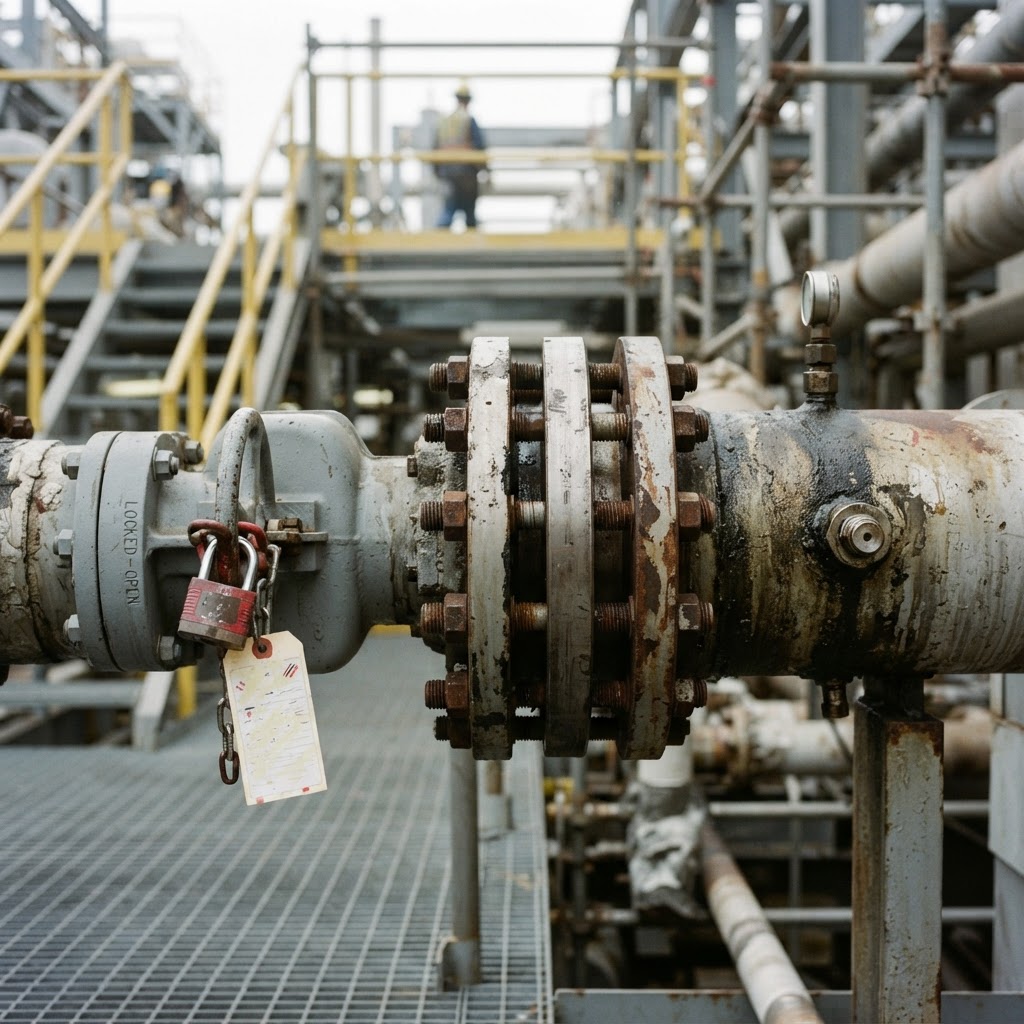
Positive isolation: why a closed valve is not enough
Valves leak, get opened by mistake and pass under pressure. Before people break containment or enter equipment, isolation needs to be proven and, for higher-risk work, physical.
The situation
Positive isolation (spades, spectacle blinds, removed spools or double block and bleed) separates equipment from hazardous energy and fluids before intrusive work. The isolation standard should match the hazard, and every step needs a certificate, verification and proven de-isolation.
The principle
Before breaking containment or entering equipment, energy and hazardous fluids must be isolated and the isolation proven. The level of isolation should match the hazard.

Levels
- Positive isolation: spades, blinds or removed spools. Required for confined-space entry and high-hazard fluids.
- Double block and bleed: two closed valves with a vent between them proven depressurised.
- Single valve: only for low-risk work, with additional controls.
Building an isolation plan
- Identify every connection to the equipment, including small-bore lines, instruments and drains.
- Select the isolation method for each.
- Mark up drawings and prepare an isolation list.
- Install, lock and tag, then verify in the field.
- Prove zero energy before work starts.
Common gaps
Small-bore connections missed from the list, isolations removed out of sequence, and long-term isolations that are no longer recorded.
De-isolation
Removing isolations is as risky as installing them. Follow the list in reverse, confirm the equipment is ready, and leak test before returning to service.
Key Takeaways
- Match isolation level to the hazard.
- List every connection, including small-bore lines.
- Verify isolations in the field and prove zero energy.
- Treat de-isolation with the same care.
How Atticus helps
We prepare isolation and spading lists, review safe systems of work for confined-space entry, and audit isolation practices.
Real-world examples
Piper Alpha — HSE public inquiry (1988)
On Piper Alpha, a condensate pump whose pressure safety valve had been removed for maintenance was restarted. The open flange was not adequately secured or communicated across shifts. This is a defining case for isolation control and permit-to-work.
Read the investigation / sourceExxonMobil Torrance refinery — CSB (2015)
At Torrance, the CSB found that the facility relied on a worn slide valve as a barrier during maintenance, allowing hydrocarbons to reach an electrostatic precipitator, where they ignited and exploded.
Read the investigation / sourceIf you get it wrong
- Release of hazardous fluids onto people doing the work.
- Fires, explosions and toxic exposure.
- Equipment damage from incorrect de-isolation.
- Prosecution under process safety and work-equipment regulations.
Relevant standards
Links go to the publisher's official page (ISO, IEC, BSI, API, NFPA, HSE and others). Most standards must be bought from the publisher.
- HSE HSG253 — The safe isolation of plant and equipmenthse.gov.uk
- OSHA — Control of hazardous energy (lockout/tagout)osha.gov
- HSE HSG250 — Guidance on permit-to-work systemshse.gov.uk
Further reading
Take this briefing with you
A one-to-two page PDF summary: situation, diagram, key takeaways, consequences, examples and standards.