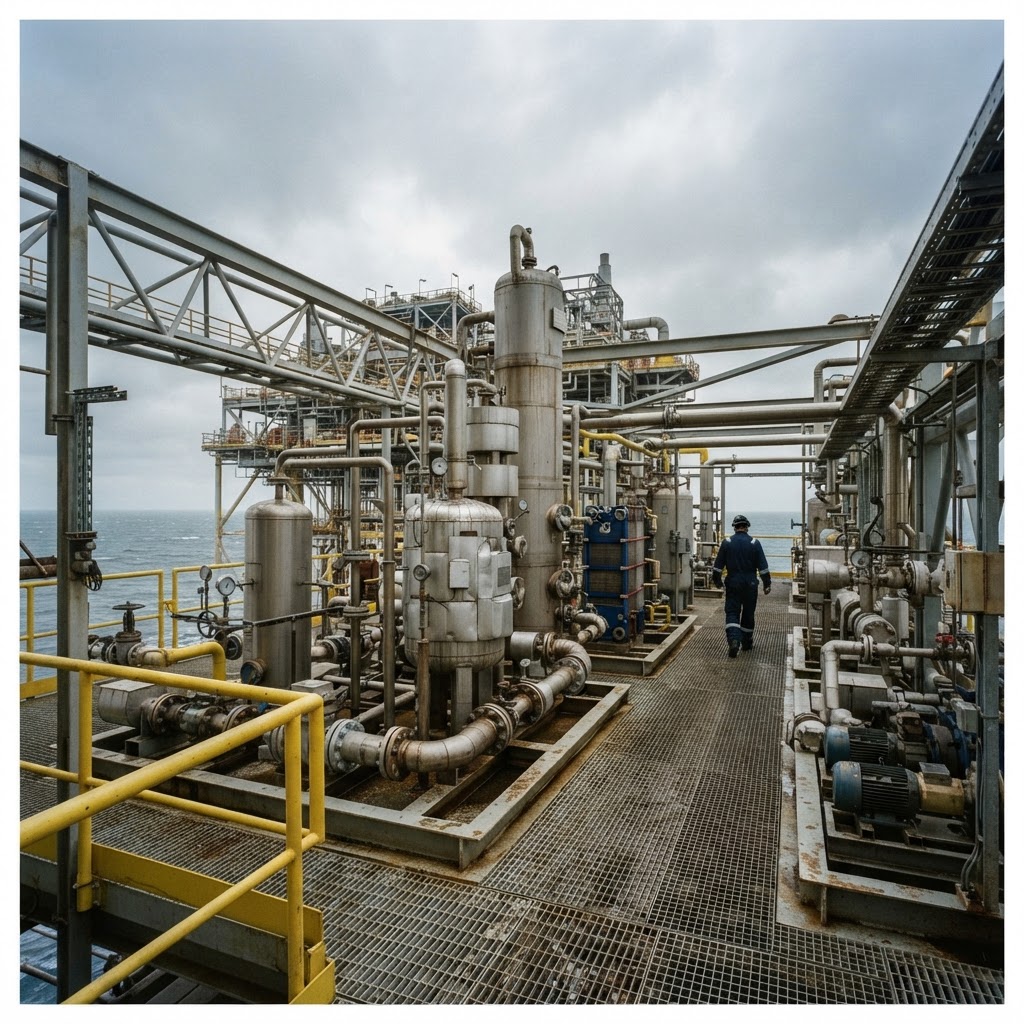
MEG regeneration and reclamation: closing the inhibitor loop
Recovering MEG makes large-scale hydrate inhibition affordable. The hard part is not boiling off water but managing the salts and contaminants that come back from the wells.
The situation
MEG used for hydrate control is recovered in a regeneration unit, which removes water, and often a reclamation unit, which removes dissolved salts. Salts, scale and degradation products from formation water are the main operational challenge.
Why regenerate
Where hydrate inhibition needs large volumes of MEG, buying fresh inhibitor is not viable. A closed loop sends lean MEG to the wells, recovers rich MEG with the produced water, removes the water and reuses the glycol.

Regeneration
Rich MEG is heated in a distillation column. Water goes overhead and lean MEG leaves the bottom. This step is relatively straightforward.
Reclamation
The harder problem is salts. Condensed water carries little salt, but once formation water arrives, dissolved salts accumulate in the loop. Without removal they cause scaling, fouling and equipment damage. Reclamation units flash MEG under vacuum, leaving salts behind as a slurry for disposal. Some systems treat only a slipstream; others process the full flow.
Design questions
- When will formation water break through, and how salty will it be?
- Which salts are present, and do any precipitate at regeneration temperature?
- What other chemicals are in the loop, such as corrosion inhibitors and pH stabilisers, and are they compatible?
- How will MEG losses be measured and made up?
Operating watch-points
Track MEG concentration, salt content and pH around the loop. Unexpected water breakthrough is a common trigger for reclamation problems, so production monitoring and the MEG system need to talk to each other.
Key Takeaways
- Regeneration removes water; reclamation removes salts.
- Formation water breakthrough changes the duty dramatically.
- Check chemical compatibility across the whole loop.
- Link reservoir monitoring to MEG system planning.
How Atticus helps
We review MEG loop design and performance, assess the impact of water breakthrough, and help plan reclamation capacity for changing production profiles.
Real-world examples
formation water breakthrough
A field started producing formation water earlier than forecast. Salts built up in the lean MEG because the reclaimer had been deferred. Fouling, scaling and corrosion forced reduced injection rates, and hydrate risk rose in the flowlines.
lean MEG quality drift
Poor monitoring let MEG concentration drift below target. Hydrate margin was lost without anyone noticing until a cold-weather restart produced a blockage.
If you get it wrong
- Loss of hydrate protection.
- Scaling and fouling of reboilers and exchangers.
- High MEG make-up costs and logistics.
- Environmental issues from MEG losses to water discharges.
Relevant standards
Links go to the publisher's official page (ISO, IEC, BSI, API, NFPA, HSE and others). Most standards must be bought from the publisher.
- ISO 20815:2026 — Production assurance and reliability managementiso.org
- ISO 15663:2021 (EN ISO 15663) — Life cycle costingiso.org
- AMPP (formerly NACE) standardsampp.org
Further reading
- Ethylene glycol (MEG) propertiesen.wikipedia.org
- Clathrate hydratesen.wikipedia.org
- Fouling and scalingen.wikipedia.org
Take this briefing with you
A one-to-two page PDF summary: situation, diagram, key takeaways, consequences, examples and standards.