Beyond Visualization: The Financial Impact of Closed-Loop AI Digital Twins
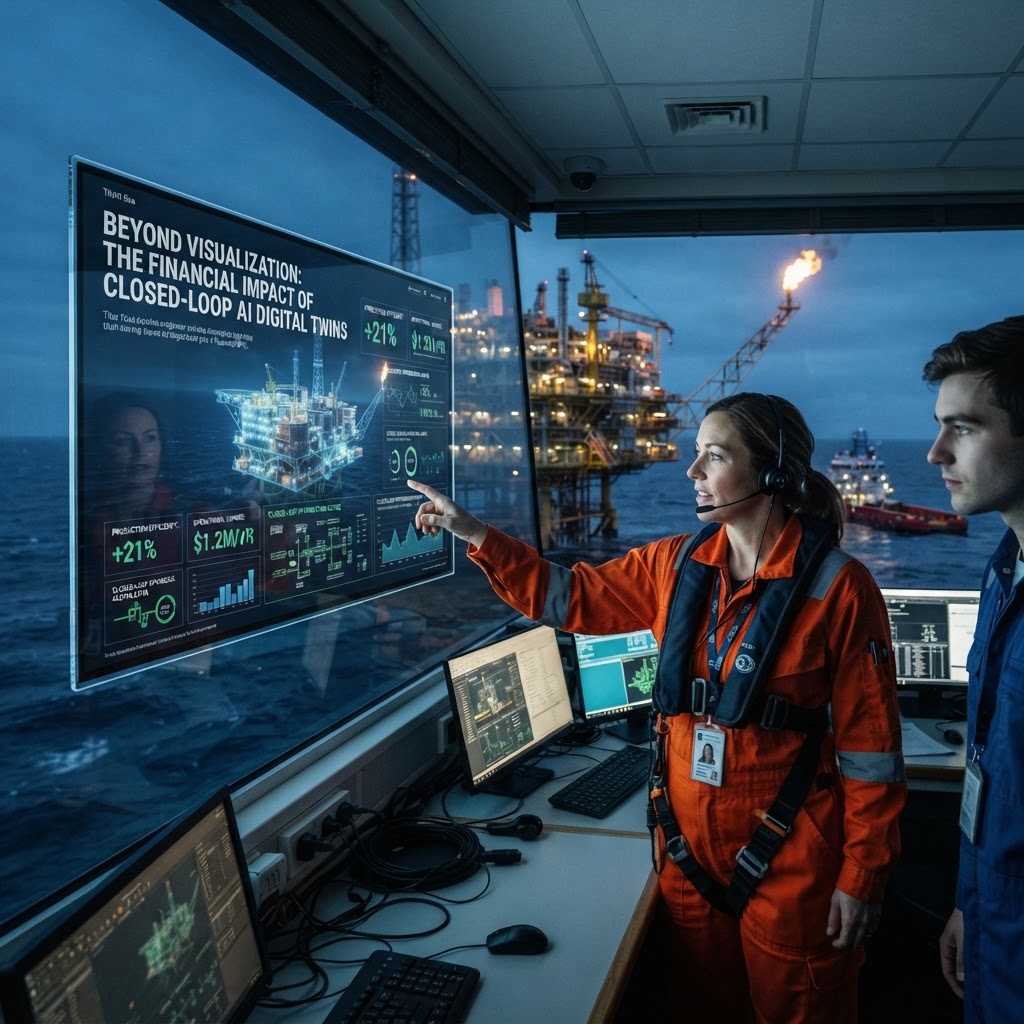
New data from August 2026 suggests that closed-loop AI digital twins are no longer just an engineering luxury, but a financial necessity, with refineries reporting a 35% reduction in unplanned downtime and significant margin recovery.
In the downstream sector, the conversation around digital transformation has historically been dominated by high-level dashboards and 3D visualizations. However, as of August 2026, we are witnessing the emergence of 'Closed-Loop AI Digital Twins' as a decisive factor in refining margins. Recent industry reports indicate that facilities utilizing these physics-informed neural networks are reclaiming an average of 3.5 operating days per year—a shift that directly translates to millions in recovered gross margin for a standard 200,000 bpd refinery.
From Reactive to Autonomous Operations
The core of this evolution lies in the shift from predictive maintenance to autonomous optimization. In the North Sea and the mega-refineries of the UAE, the integration of real-time telemetry with AI-driven models allows for the immediate identification of thermal inefficiencies. For instance, the optimization of crude distillation unit (CDU) exchanger trains has been shown to cut fuel gas usage by up to 2.5%. From a lean engineering perspective, this represents the ultimate goal: the elimination of 'hidden' waste that traditional monitoring systems simply cannot see.
The Engineering Challenge: Data Integrity
While the benefits are clear, the barrier to entry remains data integrity. As strategic advisors, we often find that the biggest hurdle is not the AI itself, but the underlying 'data backbone.' For a digital twin to be 'closed-loop'—meaning it can provide actionable, real-time adjustments back to the control system—the quality of IoT sensor arrays and DCS telemetry must be flawless. Many European operators currently struggling with gas storage lows are looking at these digital tools as a way to maximize every molecule of feedstock, ensuring that flaring and inefficient unit trips are a thing of the past.
Future Outlook: Interconnected Value Chains
The next frontier, which we are already beginning to see in pilots this month, is the interconnected twin. This links the upstream wellhead directly to the downstream refining margin in a single, living model. For our clients, this means a shift in leadership focus: moving away from managing silos to managing a synchronized, digital value chain. In 2026, the competitive advantage in oil and gas is no longer found solely in the quality of the resource, but in the precision and speed of the data that manages it.
Source: https://oithamarine.com/how-ai-digital-twins-are-cutting-unplanned-refinery-downtime-by-35-in-2026