The Strategic Evolution of EPC: Lessons from Casablanca’s Waste-to-Energy Milestone
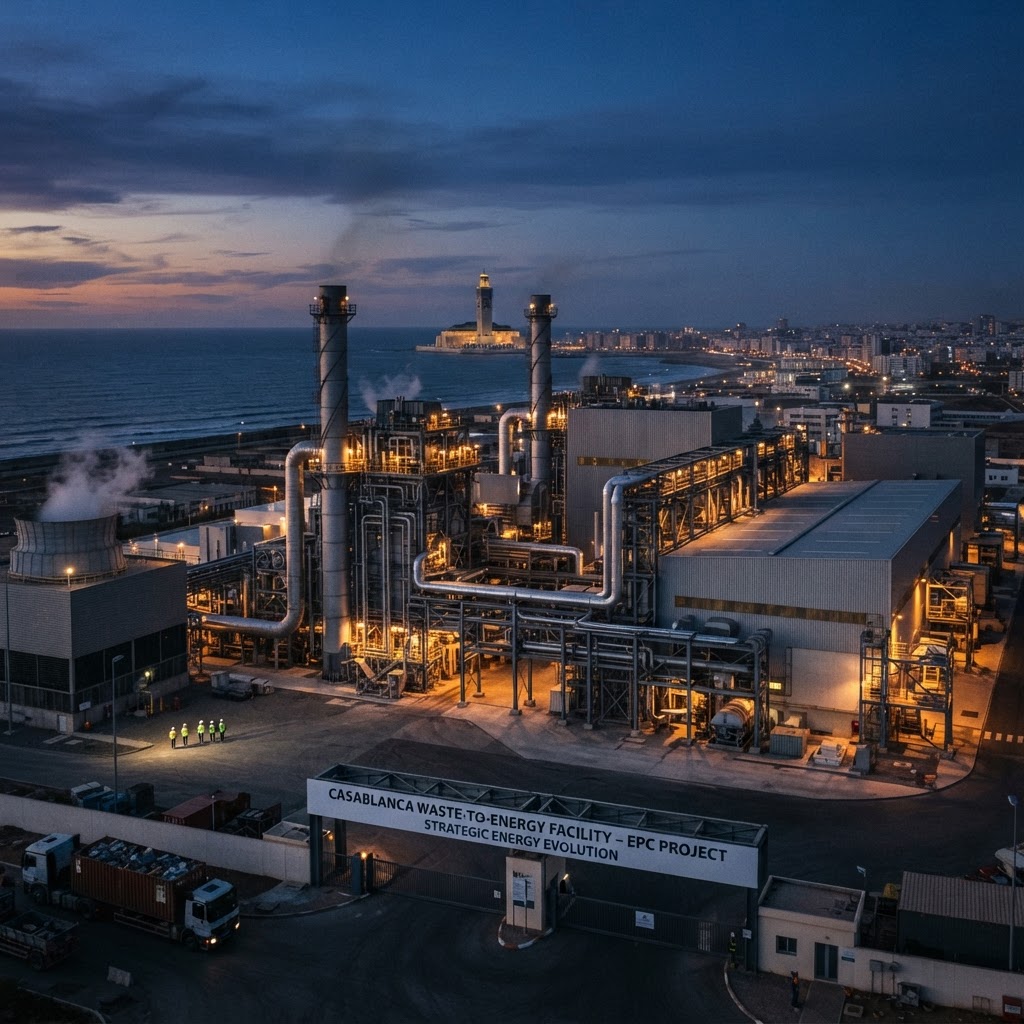
The recent awarding of a major EPC contract for Casablanca’s Waste-to-Energy project signals a broader shift in how Middle Eastern and North African energy markets are diversifying their infrastructure portfolios.
The recent announcement that a consortium comprising Nareva, Kanadevia Inova, and Itochu Corporation has awarded BUTEC a major Engineering, Procurement, and Construction (EPC) contract for Casablanca’s Waste-to-Energy (WtE) project marks a significant pivot in the regional energy landscape. As strategic advisors at Atticus Energy, we view this not merely as a municipal infrastructure win, but as a sophisticated template for the future of integrated energy projects across the Middle East and North Africa (MENA) region.
Bridging the Gap Between Waste and Power
For decades, the energy sector in the MENA region has been defined by its upstream oil and gas prowess. However, the Casablanca project, delivered under a 33.5-year concession, demonstrates a maturing approach to circular economy principles. From a lean engineering perspective, WtE projects are notoriously complex, requiring the seamless integration of thermal processing, environmental filtration, and grid-scale power generation. The selection of BUTEC for the EPC phase underscores the industry's reliance on firms that can navigate the technical rigors of large-scale industrial construction while adhering to the stringent sustainability mandates of international consortia.
The Role of Strategic Advisory in Long-Term Concessions
A 33.5-year concession agreement is a marathon, not a sprint. For project developers and investors, the risk profile of such an endeavor is heavily front-loaded into the EPC phase. Any deviation in engineering precision or procurement efficiency can have compounding effects over three decades of operation. This is where strategic advisory becomes critical. We are seeing a trend where lean engineering is no longer just about cost-cutting; it is about 'future-proofing' the asset. In Casablanca, the integration of Japanese and Moroccan expertise suggests a globalized approach to local energy challenges, a model we expect to see replicated in the GCC as cities like Riyadh and Dubai accelerate their own zero-waste-to-landfill targets.
Implications for the Regional Energy Mix
As we look toward the remainder of 2026, the Casablanca WtE project serves as a bellwether. It proves that the capital is available for non-traditional energy projects when the regulatory framework—in this case, a long-term municipal concession—is robust. For our clients in the oil and gas sector, the lesson is clear: the skill sets honed in hydrocarbon processing (high-pressure systems, thermal dynamics, and complex EPC management) are directly transferable to the burgeoning waste-to-energy and green fuels markets. The transition is not just about changing the fuel source; it is about evolving the engineering mindset to manage more diverse and integrated energy portfolios.
Source: https://ognnews.com/TagsTA/BUTEC