Bypassing the Chokepoint: Engineering Strategic Redundancy in Gulf Midstream Infrastructure
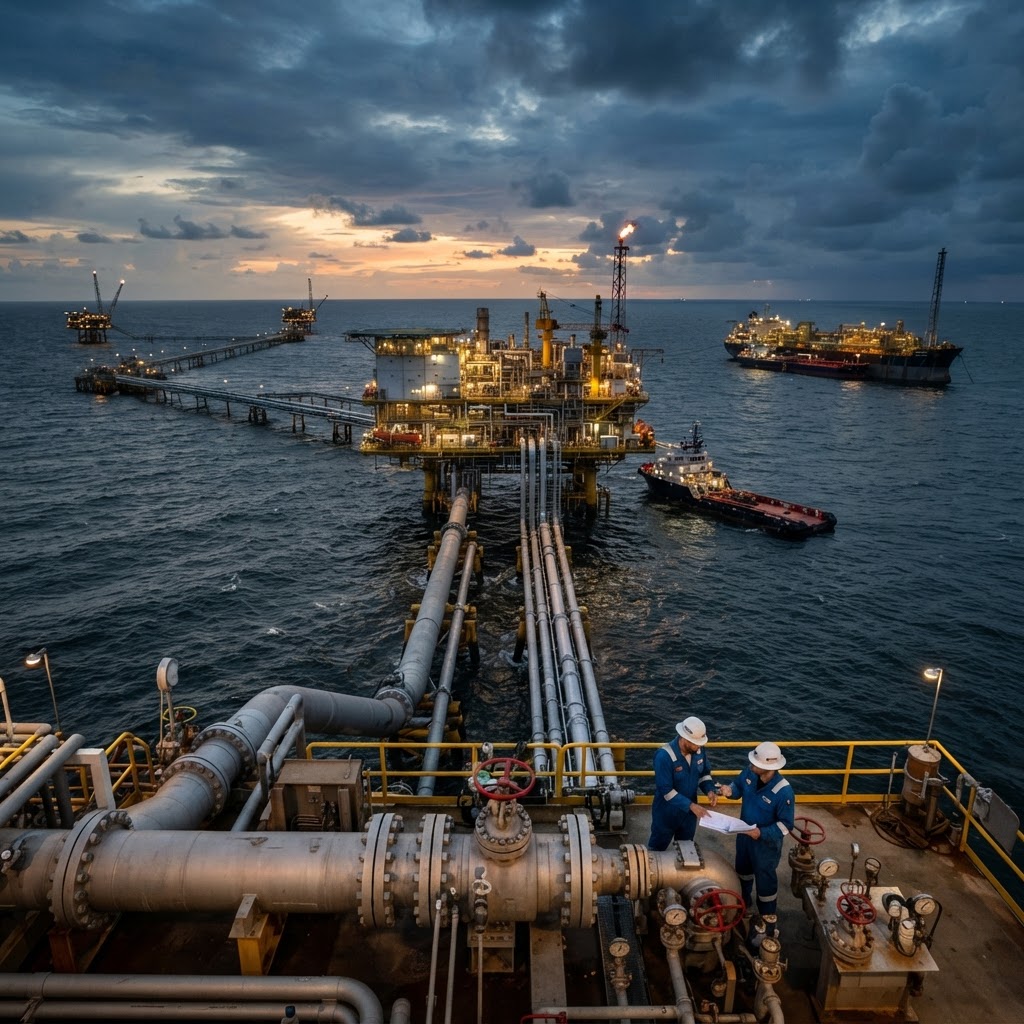
Renewed volatility across the Strait of Hormuz is accelerating Saudi Arabia and UAE pipeline bypass strategies, fundamentally shifting the engineering and commercial calculus for regional midstream architecture.
The Imperative for Redundant Midstream Architecture
The geopolitical fragility surrounding maritime corridors in the Arabian Gulf has transitioned from a theoretical risk factor to an acute operational reality. With recent naval friction and transit disruptions across the Strait of Hormuz compelling military escorts for commercial tankers and threatening regional flows, national oil companies (NOCs) are decisively moving away from legacy reliance on marine chokepoints. At Atticus Energy, we observe that export diversification is no longer an ancillary hedge; it is rapidly becoming the core engineering and capital allocation priority for regional operators.
Repurposing Desert Corridors: East-West Flow Dynamics
Central to this strategic re-evaluation is Saudi Arabia’s accelerating pivot to reroute crude flows away from the Arabian Gulf. By actively expanding throughput and debottlenecking along the East-West Pipeline (Petroline) toward Yanbu on the Red Sea, the Kingdom is demonstrably repositioning its logistics spine. However, executing such operational pivots is not as simple as flipping a valve. Repurposing domestic pipelines designed for baseline domestic or partial export flow requires intensive engineering validation, hydraulic rebalancing, and significant pump station overhauls. Operators must account for increased operating pressures, drag reduction agent (DRA) injection performance, and structural integrity across thousands of kilometers of arid terrain.
Furthermore, maritime export terminals on alternative coastlines—such as the UAE's Fujairah hub outside Hormuz and Red Sea offshore load points—require swift topside and subsea debottlenecking. For offshore and marine engineering teams, installing additional single point mooring (SPM) calm buoys, boosting subsea manifold capacity, and upgrading metering systems are now high-priority Capex mandates designed to turn secondary loading points into primary global energy conduits.
Commercial Advisory: The New Capex Baseline
For independent operators, joint venture partners, and engineering consultancies, this operational pivot signals a lasting shift in capital program design. Future regional midstream assets will demand embedded redundancy at the Front-End Engineering Design (FEED) stage. Midstream contracts are increasingly factoring in flexible routing, dual-terminal discharge capabilities, and localized terminal storage expansion to absorb supply chain shocks. In an era where transit disruption can swiftly escalate benchmark volatility and inflate maritime insurance premiums, midstream resilience will dictate balance sheet integrity.
Source: https://ognnews.com/